What’s New about Aliso
Published on Medium.com on January 16, 2026

Ever since I finalized the 2025 edition of my book Incompetent, Corrupt, or Impotent: How public agencies mishandled the Aliso Canyon disaster in the San Fernando Valley in early October, there have been topics that need updating.
I will refer to specific pages in the book.
THE FIRST BIENNIAL ASSESSMENT TOWARD THE PATH TO CLOSE ALISO CANYON
As 2024 was ending, many activists and residents were not happy with the California Public Utilities Commission (CPUC) decision (page 317 in the book) to postpone implementing a timeline for closing Aliso.
The press release called the decision a path to closing down Aliso. It set a target level of 4,121 million cubic feet per day for peak day demand for two years. When this target is met, a biennial report will recommend that a proceeding be open “to review the conclusions and address any relevant issues related to permanent closure and decommissioning.”
The first biennial assessment was to be released in June 2025. SoCalGas asked for two extensions (this is a pattern of behavior on the part of the gas company, as during the proceeding 17–002–02, it asked for many extensions).
Finally, the first assessment came out on October 1st, more than three months late.
According to the report’s “Recommendations and Next Steps,” there should be movement soon on the Aliso front. The report states, “The four analyses conducted for winter 2025‒26 support a Staff recommendation to reduce the Aliso Canyon maximum inventory by 10 Bcf to a level of 58.6 Bcf.” The recommendation did give some wiggle room for the Commission to consider a smaller reduction.
The report ended with this statement, “Therefore, SoCalGas is required to file an application within 90 days asking the CPUC to review Staff’s recommendation as well as SoCalGas’ recommendations, if any. Within 90 days of the filing of the application, SoCalGas is required to hold a workshop during which Staff will present the Biennial Assessment Report, and SoCalGas will present its application. The Aliso Canyon maximum inventory will remain at 68.6 Bcf unless and until a change is required by a decision in that proceeding.”
It reminds to be seen if SoCalGas will follow this directive, and if so, will the CPUC push for more decarbonization efforts to make closing the facility sooner than later a reality. In the meantime, there will be another biennial assessment in 2027.
DID VALLEY ORGANIZATIONS GET SNUBBED FOR SUSTAINABILITY GRANT?
As part of a package of sustainable projects funded by funds assessed against SoCalGas, $2 million was allotted to “Community Outreached and Building Decarbonization Education.” (Pages 313–315.) Community-based organizations (CBOs) serving the Aliso-affected communities and San Fernando Valley were to be prioritized for this Clean Energy Access — LA County TECH (CEA-LAT) grant program, according to the Grant Application Guidelines.
The deadline to apply was June 30th, but the awardees weren’t announced until November. After several months of review, eight organizations were awarded the grants to provide outreach and education on the TECH Clean California Initiative, including decarbonization’s health benefits, and make TECH more accessible to those who would like to participate.
The eight organizations named and the amounts of their grants are: Climate Resolve, proposed funding: $200,000, El Sol, proposed funding: $199,971, International Institute of Los Angeles, proposed funding: $181,853, Breathe Southern California: $137,284, East LA Community Corporation: $149,995, Pacoima Beautiful: $144,083, ONEgeneration: $133,803, and US Green Building Council California: $149,944. The last five were given ministerially.
But at least two of the selected organizations are not involved with the listed communities of Porter Ranch, Granada Hills, Northridge, Chatsworth, North Hills, Canoga Park, Reseda, Winnetka, West Hills, Van Nuys, and Lake Balboa as the “Aliso Canyon Disaster Area.”
By its website’s admission, the East LA Community Corporation’s mission is “to advocate for economic and social justice in Boyle Heights and unincorporated East Los Angeles.” East Los Angeles is a major distance from the priority area.
El Sol provides programs in the Inland Empire, which is not located in L.A. County. That means that the organization is also a great distance from the San Fernando Valley, more than 75 miles.
The guidelines for the CEA-LAT grant state, “Successful applicants for the CEA-LAT Grant will have a demonstrated background in advocating for their chosen target community in these areas.” Certainly, El Sol and East LA Community Corporation would not be experienced with the target communities.
How can two CBOs that have not been involved in the San Fernando Valley provide outreach to SFV residents if they don’t know the avenues for reaching them? Would they know of potential venues for holding town halls that are located here? Would they be attending the local neighborhood council meetings throughout the approximately 48 square mile priority area? Do their mailing lists reach a high percentage of those who live in the affected areas?
Another of the CBOs mentioned, Pacoima Beautiful, serves the east San Fernando Valley communities of Pacoima, Arleta, and San Fernando. But these are not listed as prioritized communities. In 2016, this organization even called for the reopening of the Aliso Canyon facility, despite the risks it poses to approximately one million residents.
The International Institute of Los Angeles does have offices in Canoga Park and Van Nuys, but its website seems to show a focus on immigrants (who do need their services, especially with the current administration, but perhaps it isn’t the right organization for this specific outreach program).
According to CPUC Resolution M-4881, Climate Resolve’s work plan is to make “6 neighborhood council presentations,” when there are 15 neighborhood councils in the target area. Is this organization planning to ignore much of the prioritized area?

Regarding the influence from SoCalGas, there is a concern about some of the organizations that have a connection to the gas company. In 2019, Climate Resolve gave an award to a top executive of SoCalGas for its fossil fuel biomethane project. The US Green Building Council lists SoCalgas as an “annual sponsor” on its website.

In the GO-77M reports I found (2014–2017, 2019–2024), these organizations have received these totals from the gas company: Breathe Southern California $138,000, Climate Resolve $41,500, US Green Building Council California $28,550, and Pacoima Beautiful $92,500.
The optics of allowing groups, which have benefited from the gas company’s largess, to work on outreach for a project that is intended to reduce the need for SoCalGas doesn’t seem right.

RESIDENTS COMMEMORATE A DECADE OF BEING GASSED BY SOCALGAS
Save Porter Ranch, Food & Water Watch, and this writer decided to commemorate the tenth anniversary of the blowout with a town hall that was held on October 26th. The plan was to discuss many of the issues important to community members and give them hope that eventually we can get the facility closed.
The emcee, Andrea Vega, of Food & Water Watch, said, “It’s unconscionable that this facility is still allowed to operate and that SoCalGas is still allowed to profit off of poisoning our community.”
The co-founder of Save Porter Ranch (SPR), Matt Pakucko explained that SPR was started a year and a half before the onset of the gas blowout in order to help stop the expansion of Termo’s oil field and the development of Hidden Creeks, which is just to the west of Porter Ranch (Page 275). He displayed the first graphic used by SPR that showed all the oil wells in Aliso Canyon and in the neighborhoods to the south.

“Half of those are gone, plugged, sealed over. That’s when it hit me. How we, the residents, and Food and Water Watch and Save Porter Ranch, did that.” He added, “Not because of any governmental agency that’s supposed to protect us, and it certainly wasn’t because of the corporate criminal that perpetuated this crime on us. It was us refusing to be gas lit by corporations, by our own state, by our own agencies, by our own health department, by state officials, by the haters.” He said that because of this environmental crime, many of us got to know ourselves and our community
He added that people’s health improved when they moved away.
He also discussed that various mitigation methods, employed while the site was offline for 19 months. kept the lights on. Talking about the resumption of operations, he said, “Within two weeks, one third of the wells leaked again.”

He discussed the many accomplishments done by residents and activists, including getting SB-380 and SB-887 passed (Page 32), attending South Coast Air Management District (AQMD) abatement hearings (Pages 47–53, 65–69, 71–74, 77–79, and 84–85), and turning the state’s attempt at the two-day dog & pony show into a community forum (Pages 238–241). He also mentioned that they blockaded the SoCalGas gate on several occasions (Pages 251–252 and 268–270), one of which resulted in 19 people being arrested, as well as many demonstrations, protests and rallies. “We’ve met with every elected officer all the way up to the governor’s office. We’ve been in hundreds of TV, print, radio, and online media appearances.”
He said that he is sharing these achievements and actions to demonstrate that the community is not powerless. “SoCalGas would have gotten away with it and still denied that there was ever a leak if we haven’t gotten involved. These wins only occurred because of people here who showed up, spoke up, and never gave up.”

Dr. Christina Batteate, Research Program Manager for the UCLA Center for Occupational and Environmental Health, took the podium next to give updates about the health study (Pages 149–154). She explained that the goals are to understand all the toxins that were emitted by the facility ten years ago and what people were exposed to so an appropriate evaluation can be designed, and to understand the short and long-term health impacts. She talked about the team and the various sources of data that are being collected, including requests being directed to specific agencies.

She also previewed what was going to be described in the next community meeting. She summarized the findings that have been mentioned at the past community meetings. Before answering questions, she told residents to look for an envelope in the mail that would be randomly sent to homes in the study area. Those completing the survey can request to be a part of the clinical assessments.
A new report will be released the week of the town hall showing the satellite imaging showing where the plume was, and the focus group finding will be published in November as well as one looking into emergency department visits.

Dr. Jeffrey Nordella, who was the first local medical doctor to look into the health impacts from the blowout (pages 82–83, 89, 104, and 106) gave a presentation entitled “Aliso Canyon Blowout 10 Years Later.” He started a discussion about fetus development, explaining that there are three structures of concern: the fetus, the placenta, and the amnion complex (membranes that make the amniotic fluid). He said the placenta is a vascular system and the placenta’s function is to screen and allow blood products, oxygen, CO2, and nutrients for development into a developing fetus.
The fetus is very small but a toxin dose can be very, very big. He said that in the case of a pregnant woman who’s been exposed to toxins, which are foreign, the body fights them off as an immune response. The immunity response is basically a foreign chemical or molecule that gets into a cell and calls out to other cells. The toxins leave the body through the kidneys. He mentioned that during the first trimester of pregnancy, the amniotic fluid comes from the mother, but during the second and third, the amniotic fluid comes from the fetus. In the developing fetus, when the kidneys are starting to develop, the entering chemicals are eventually urinated into the amniotic fluid, which gets into a “circulation pathway” of re-exposure.
When this process of the chemokines and cytokines “calling” the immunity system into action to rid the chemicals, the toxins are metabolized by the liver, go to the kidneys, and the kidneys eliminate the toxins.
Dr. Nordella next discussed the design of the UCLA study and the three control groups: state, Los Angeles County, and a matched control group. He said it is a good study based on good science, but he has some criticisms.
He explained that a statistical analysis between the Aliso Canyon area and L.A. County shows there’s no significant difference. But when he looked at the matched community, there was an incredibly significant difference. He wondered why they didn’t further evaluate that.
He talked about the birth outcomes study that was published. He said there were three outcomes discussed: preterm babies (less than 37 weeks), termed babies with low birth weights less than 2,500 grams (5.5 lbs), and babies with low birth weights. All three of these parameters carry long-term health effects.
He said that you can look at any organ system (neurological, UI, musculoskeletal, immune system), it’s all altered and studies have shown that this will go throughout the life of that particular fetus, as they become a child and then an adult. “It’s very high risk.”
He asked, “Has anybody been informed those families? Has the Department of Public Health reached out to them when they can, and say “Hey, you’re high risk”? Wouldn’t you want to know?”
“Most important to me is the cancer data,” he said, adding that one of the three things disappointing to him is that the researchers stopped looking at the data in 2019. “Why not look all through up to this date?” He pointed out that there are three phrases of toxicity when it comes to Aliso Canyon: pre-blowout, the blowout, and post-blowout.
In answer to questions from attendees, he said that if off gassing is occurring, which is likely, residents’ health are being affected.
He explained that cytokines are measurable. When one has inflammation as a result of a toxic molecule that gets into a cell, it triggers a reaction and the cytokines are released that can be measured. When someone is being chronically exposed, their cytokines are going to be elevated.
For a pre-term baby, the placenta after birth can be sent to pathology to study.
He emphasized that the matched group in this study needs to be from a “clean community” which has not been exposed to toxins.

The next presenter was Kyoko Hibino, co-founder of SPR and a wellness architect certified in material health. Her company is Happiluxe Design.
She mentioned that many doctors are not knowledgeable about toxins or may have concerns regarding litigation. They might attribute some health problems to just stress or age or just in our head.
She brought up that when the blowout was occurring, the health dept and AQMD said there will be no long-term health effect. “But those of us who live through it know that’s not true. We were left alone to figure out how to protect ourselves.”
Her presentation is about her experiences and what she found helped her body recover and detox safely.
After moving to Porter Ranch, and then experiencing the blowout, she started having health problems. In 2020, she was diagnosed with breast cancer. When she later faced a possible reoccurrence, she realized she had to find a detoxing method that worked for her. “Over time, I discovered what actually worked to restore balance and health. Now I am cancer free, stable, and rebuilding my strength.”
She prefaced her plan is not medical advice, but experienced-based science-supported guidance. She said that we’re exposed to small amounts of toxins everywhere from air, water, food, and the products we use.
In addition, those who live in Aliso Canyon have the extra chemical exposure for years. The body stores what we cannot eliminate and this is built up over time like a bucket, and called a body burden. When the bucket overflows, symptoms appear like fatigue, brain fog, allergy, a hormonal imbalance, and insomnia.
She took several biomarker tests, which showed that her detox pathway was sluggish and not fast enough to process toxins that were circulating instead of exiting from her body.
She described the steps in her plan to detox the body, starting with the colon. Step two is detoxing the liver. Step 3 concerns drainage and detox habits. After that is Step 4, which is a deep detox.
After explaining the details, including diet, she said, “Detox is not a punishment. It’s self-care in the toxic world.”
Pakucko returned to the podium for some final words. He said that agencies and elected officials will point to new laws and regulations. But he pointed out, “These are administered by the very same agencies and institutions that came up with the previous set of laws that they didn’t enforce.”
He said that notifications for the town hall were sent ahead of time to elected officials and many like county supervisor Lindsey Horvath and council member John Lee didn’t mention the event in their newsletters or on their websites. “PRNC, you guys helped us get this room a few weeks ago. Nothing on the website, nothing in the newsletter even after specifically asking them.”
Pakucko also talked about AQMD’s Rule 1148.2, which requires SoCalGas and other utilities to send out notices when they’re going to be doing operations that will emit airborne contaminants, reciting some of the recent notices.
“Alert without action, that’s just theater,” he said about all the noneffective actions taken by public agencies and office holders.
He also discussed the Sunshine Canyon garbage dump (Pages 328–332). He said it was an issue even “before they dumped hundreds of thousands of tons of L.A. fire hazmat debris. The county approved it. It’s not rated for hazardous material, but the county waived that requirement.”

About Aliso, he said, “So, here we are because of this avoidable environmental crime. It changed our lives. But the record shows that this community also changed the system measurably and undeniably. We shut it down for two years. We cut the number of wells. We cut the capacity. It’s not a story of defeat. It’s a blueprint.” He added, “If we keep organizing, keep documenting, keep showing up, keep each other notified informed, we’ll keep winning.”
Andrea Vega reminded the attendees about the fight and the need to keep reminding the governor to keep his promise to shut it down.

Brad Sherman, one of the members of Congress who represent the areas affected by Aliso, talked about the need to shut Aliso Canyon down as well as to analyze the health effects. He praised Dr. Nordella for his efforts in educating residents.
He discussed how he wanted The Pipeline and Hazardous Materials Safety Administration (PHMSA), which regulates the pipelines that carry oil and gas throughout the country, to inspect the facility. He also feels SoCalGas should have been looking for alternative ways to provide methane for Southern California without the use of Aliso Canyon. He added, “We need to move forward to a carbon-free system of providing energy for the people of this city and the world.”
Playa del Rey’s gas storage facility, the current Environmental Protection Agency (EPA), and a failure on the part of the Department of Public Health to pass on the findings of the UCLA study to the CPUC were also brought up by attendees.
Issam Najm, who was a party to the CPUC proceeding that concerned whether Aliso could be closed down or its use minimized, explained that unfortunately, the CPUC code doesn’t include accounting for community impact in their proceedings. He suggested that Sherman could help lobby state legislators to insert a change in the Public Utility Code that requires that community impact be part of every proceeding. “Right now, it’s not in there, and they hide behind that fact.”
Here are YouTube videos of the town hall:
Helping to publicize this event were members of the Aliso Moms Alliance as well as mentions in Laist/KPCC and Daily News articles. Three neighborhood councils, Granada Hills North, Granada Hills South, and Northridge East, put the event on their calendars on their websites.
THE LATEST ON THE HEALTH STUDY
The health study team held its fall community meeting #6 on November 18, 2025. After the meeting, the video, PowerPoint slides and meeting summary were placed on the website.
As mentioned in my book, one of the Community Advisory Group’s priorities for the health study was a clinical study looking into the effects of the blowout on residents. (Pages 105–148.) That part of the UCLA study (Pages 149–154) is now underway. Invitations to take part in the health survey started being mailed to homes in the targeted area. Each resident who completes the survey will be given a chance to indicate interest in taking part in the clinical assessment. Dr. Michael Jerrett said the clinical assessments have been designed “so we can detect those longer-term effects and also see whether or not people living here are less healthy for reasons related to ongoing operations.”
Dr. Honghu Liu explained the survey letters are being sent in batches to randomly selected households in the affected area and in a comparison community. He added that any residents who have received the invitation can also get help from the team to complete the survey by telephone or in person, as well as ask questions about the clinical exams being offered.
As of the meeting date, 100 participants have completed the survey and more than 30 percent of those have expressed an interest in the clinical assessment.
Dr. Wendie Robbins said that the clinical assessments are being done at the Vineyards Community Room in Porter Ranch and the Simi Valley Marriott. The four stations will check for specific health aspects.
Station One will check vital signs and anthropomorphic measures (blood pressure, heart rate, oxygen saturation and temperature as well as measures of height, weight, and waist to hip ratio).
Station Two involves taking blood work and urine samples. These will measure the complete blood cell count, differential and platelets, total protein and protein electrophoresis assay, comprehensive metabolic panel, lipid panel, c-reactive protein, Il-6, and TNF-alpha (the last three will test for immune and inflammatory markers).

Dr. Dean Jones of Emory University explained the blood analysis will include metabolomics assays (which will look at the different metabolites, small molecules in the body, which can indicate a marker of exposure). These biomarkers of risk of adverse outcomes can be linked to health concerns.
Nurse practitioner Joanne Fierro explained that the third station will be for the cognitive assessment to test language, memory, thought processes, and attention. She said that exposure to gas may cause neurological deficits.
The final station will involve spirometry (a lung function test to measure the amount of air being exhaled).
Some of the questions asked by attendees included if there was any impact from the January 2025 fires. Jerrett said that researchers used a hazard mapping system to look at satellite images, ground data, and air monitoring. “Remarkably, there was very little impact from the wildfires in this area,” as opposed to downtown Los Angeles and some areas in the Palisades, he explained.
Another question concerned the effect of the emissions from Aliso for years before the blowout. Jerrett said that they were concerned about that and are using a chemical transport model from Dr. Michael Kleeman of UC Davis that covers the year from 2012 to 2019.
Dr. Jerrett said, “We’re also looking at metabolomic profiles from blood spots that were taken from babies born in the affected area before, during, and after.” He added that they have met with the leadership of the California Biobank Program, which will be processing their request for the blood spots. They have also looked at premature or low birth weights before, during, and after the blowout, and emergency room visits. They also will use analysis from the California Health Interview Survey.
One question concerned inflammation, as described by Dr. Nordella at the October town hall. Dr. Jerrett said that several of the blood tests will look into markers of inflammation.
As for data during the time the facility had been offline, Jerrett said Aliso was still operating down to what’s known as a cushion level of about 35 to 40 percent of its full capacity, while during the blowout, it was 75 to 80 percent. He said they have emissions data from the gas company and the state which they feed into the chemical transport model to see what levels of benzene, toluene, xylene, ethylbenzene, and particulate matter that may have been emitted and potentially reduced during that period.
In answer to a question concerning lessons learned about ongoing underground facilities, such as the SoCalGas ones, he admitted they haven’t measured health around Honor Rancho or Playa del Rey.
As for the timeline for getting the blood spots, he said it’s a very large request of 2,600 specimens, and the biobank’s short-staffed. But they should be getting batches of 600 at a time over a period of six months, probably starting in February.
One question expressed concern about Simi Valley being used for the comparison group because of its proximity to the Santa Susana Field Laboratory, which has caused contamination nearby. Jerrett said that the area will be at least two miles away.
The next item on the agenda concerned sampling of gas in homes in the affected area. Dr. Jerrett said regarding SoCalGas’s lack of cooperation in disclosing information on the composition of their gas, they are using “contam modeling,” a simulation model of what could be the composition of the gas and other variables (such as the ventilation practices of residents inside the home), we can simulate whether they have been exposed to high levels of benzene and air toxins inside the home.
Dr. Eric Lebel of PSE Healthy Energy presented preliminary results from the sampling of gas stoves. (See pages 159‒160 about his other studies, including the 2021 study of homes throughout California. That study showed elevated levels of benzene and other toxins in homes in the San Fernando Valley and Santa Clarita, areas served by the Aliso Canyon underground gas storage facility.)
For the UCLA study, Lebel’s team looked at the present day gas composition, focusing on benzene as it’s the most toxic of the chemicals found in gas from storage facilities. The researchers wanted to see if benzene is elevated in the affected area compared to communities farther away and then test whether the composition has changed by comparing the results from 2021 with present day.
Samples from gas stoves were collected every two months for a year in the impacted community (5-mile radius to the site), in Simi Valley, and at four homes considered to be “regional background.” A total of 128 samples were taken starting in June 2024 and ending in April 2025, with 95 in the affected area. The samples are 100 percent pure methane gas before it gets burned in underground pipes.
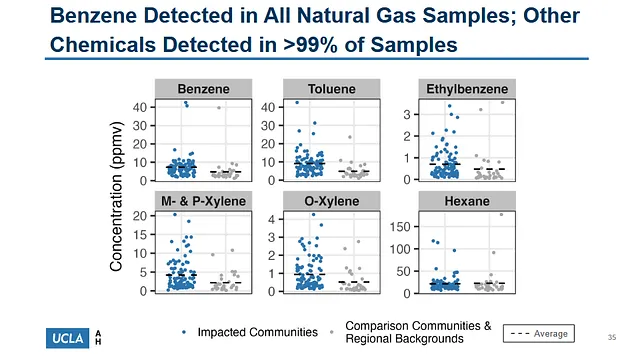
A higher average of benzene was found for the affected area homes plus those have more outliers in the bar graph, with the difference being statistically significant.
Of note in the 2021 study, the average benzene level in the impacted community was similar to some other western cities such as Vancouver, but higher than some California cities like San Francisco, Sacramento, and San Diego.
The samples were analyzed for over 50 different chemicals, including the BTEX chemicals plus hexane.
A contam model, estimating indoor pollutant levels based on home size as well as ventilation like window opening, was used.
Attendees asked about the exposure to crude oil and toxic soups. Lebel said that they’re using a chemical transport model to determine the ratio of benzene to methane in the samples. “We do see that the benzene content of what was coming out during the leak was much, much higher, hundreds of times higher than what we see in the unburned natural gas that’s going into people’s homes today,” he said.
About the scrubbing of gas, Dr. Jerrett said they had collected samples of benzene near the well during the blowout. They don’t believe benzene is being removed through scrubbing as that process targets other substances like hydrogen sulfide and toluene, but they have asked the CPUC and the Office of Environmental Health Hazard Assessment (OEHHA) to investigate.
As for the high levels in the control areas that were collected near the Playa del Rey gas storage facility, the researchers saw a pattern of samples tending to have higher levels of benzene than found in other locations.
In answer to one question, Lebel said they’re testing gas stoves only as those appliances are found in the kitchen, while other appliances might be outside the main part of a house and generally have a dedicated vent. He also explained that the World Health Organization (WHO) and the state have two different standards as to the safety levels for benzene. The WHO says there’s no safe level in regarding to its cancer-causing potential. But the California threshold concerns the reproductive toxin level.
The next topic was indoor and outdoor air sampling done at homes in the affected and comparison communities to identify if there are currently elevated levels of pollutants. In 40 homes, the researchers looked for fine particulate matter PM2.5, benzene, and lead. The other homes involved were in the control area in Simi Valley with other homes located in the urban areas of Los Angeles. Two homes were located near the Playa del Rey gas facility. Dr. Yifang Zhu’s team also compared the data they’ve collected to available data reported previously by the AQMD throughout the Los Angeles metro area.

The methodology used two-week integrated air sampling (February 2024 to June 2024 and then October 2024 to May 2025, with the second one paused during the fires).
She said they found no evidence of a particularly higher risk for toxics in the impacted community compared to other parts of L.A. The outdoor benzene levels were within California state guidelines. There were no significant differences between the two rounds or between the impacted communities and the other areas.
They also looked at data from the AQMD’s multiple air toxin exposure study done in 2018 and 2019 involving 10 monitoring sites in LA county.
Dr. Zhu noted that the measurements of PM2.5, lead, and the other 20-plus metals they analyzed were below EPA standards.
“While this is reassuring, it is always important to remember that low exposure does not necessarily mean zero risk, particularly for carcinogens such as benzene,” she concluded.
She said the indoor and outdoor air quality report is on the health study website under “resources.”
Attendees asked about the analysis and regulatory standards, especially about the OEHHA threshold. Concerns were raised that the longer-term averages presented do not reflect potential short-term peaks.
Dr. Jerrett said that the OEHHA standards were last amended in 2014. As for detecting peak levels, Dr. Zhu said they didn’t have the instruments needed to measure real-time benzene concentrations.
The last part of the meeting was devoted to status updates. Dr. Jerrett reviewed the studies that have recently been published including the birth outcomes analysis, which was peer-reviewed and published in Science Advances.
Another study, concerning the imaging of the extent of the methane plume during the blowout, was published in Environmental Research Communications.
Social Science & Medicine published the study on focus groups and mental health.
He said that studies that will soon be submitted include one on the changes in emergency department visits as an indicator of health impacts, as well as one on exposure risk assessment methodology.
As for the Resident Health Survey that is underway and Clinical Assessments, Jerrett pointed out that even though they’re getting a good response to the survey, the clinical exams in the affected community would have been lower than what we would have expected. (As of December 18th, over 256 surveys have been completed, and 42 clinical assessments have been scheduled or completed.)
He mentioned that UCLA is procuring additional years of California Cancer Registry (CCR) data to conduct and enhance cancer analysis. He explained that the Scientific Oversight Committee (SOC) “recommended this so we could increase statistical power to differentiate between the affected communities and those who are farther away and unaffected.” Also in the works is an analysis of California Health Interview Survey (CHIS), healthcare utilization, cancer, and exposure data are ongoing; and the State of California Biobank shipping of blood spots for the metabolomics analysis.
He pointed out Dr. Christina Batteate has cataloged data sources compiled for the risk assessment and posted data inventory on the website.
He said the UCLA team meets regularly with the SOC, which provides guidance for the study and will independently evaluate the 3-year report to assess whether the Health Study is on track to achieving its goals. The next meeting was scheduled for December 2nd with the team submitting a three-year progress report on December 11th.
To answer a question about whether the SOC had expressed any concerns, he said, “I don’t think they have concerns. They’ve certainly given us a lot of advice on how to make the study better about changes and adjustments in the scientific direction, but they’re not expressing any concerns about the progress.”
It was mentioned that Dr. Batteate had been going through many documents supplied to the team from SoCalGas. But the key piece of info missing is video during the kill attempts when SoCalGas used a lot of mud that was filled with many possible toxic substances. “Many of which we think showed up in your homes. We’ve reached out to other lawyers that were involved. Our UCLA counsel has reached out to other lawyers that have been involved in lawsuits to see if they can supply any info. We’re going to meet again with the gas company. The CPUC has said that they’ll try to arrange that meeting, get cooperation for us. So we are still lacking some of the key info about those kill attempts but we have pretty good info about the benzene levels that were close to the site,” Jerrett said.
In terms of publicizing this event, the only nearby neighborhood councils that listed it on their calendars were the Granada Hills South and the Northridge East Neighborhood Councils.
A COUNCIL MEMBER FINDS OUT HOW MUCH A VEGAS TRIP REALLY COSTS
In 2023, the Los Angeles City Ethics Commission brought an accusation against council member John Lee into whether he violated rules regarding accepting and reporting gifts. (See pages 279‒281 of the book.) Between that time and when the Ethics Commission’s decided at its November 2023 meeting to start the process for a hearing, Lee filed a lawsuit on the basis that the statute of limitations have passed. But a state judge ruled that the administrative hearing could be held. That hearing was held June 2 through June 6, 2025, by videoconference with Administrative Law Judge (ALJ) Ji-Lan Zang presiding.
On December 17, 2025, the Ethics Commission held a special meeting to decide the fate of the ethics charges brought against Lee.
The commissioners were given a package of documents to consider, which included the 2023 Accusation; the ALJ’s recommendations; the recommendations of Kenneth Hardy, the Director of Enforcement, and his response to the ALJ; John Lee’s response to the ALJ’s recommendation (written by counsel Amber Maltbie of Nossaman LLP and Brian Hildreth of Bell, McAndrews & Hiltachk); a procedural memorandum from the City Attorney’s office; the Director of Enforcement’s penalty brief; and Lee’s penalty brief.
Before the commissioners took up the matter, public comments were taken in-person and by phone. The comments in favor of penalizing Lee centered around the violations, that the council member needed to be held accountable, that what he did should be considered a misuse of his city authority, that he ran for office, even though he knew his previous boss was under investigation by the FBI, and that given the current corruption at the federal level, local ethics enforcement is more important than ever.
Those who wanted the charges dropped said that Lee was a victim of politics, that he has been serving CD-12 well, that he keeps getting reelected, and for one person, that he helped her organization. One even said this was “an investigation by people who are not allies of John Lee.”
For the sake of the discussion, I will refer to specific page numbers of the document package PDF.
The counts listed in the Accusation (spelled out on pages 10–11) are:
COUNTS 1–2: ACCEPTING EXCESS GIFTS
COUNT 1: Lee accepted gifts in 2017 from Businessperson A (Andrew Wang).
COUNT 2: Lee accepting gifts in 2017 from Developer A (Christopher Pak).
COUNTS 3–5: FAILING TO DISCLOSE GIFTS
COUNT 3: Lee failed to disclose on his annual Form 700 the gifts that he had received from Wang during 2016.
COUNT 4: Lee failed to disclose on his leaving office Form 700 the gifts he had received from Wang during 2017.
COUNT 5: Lee failed to disclose on his leaving office Form 700 the gifts he had received from Pak during 2017.
COUNTS 6–9: MISUSE OF POSITION
COUNT 6: Lee misused his position as Mitchell Englander’s Chief of Staff in 2016 and 2017 as a vehicle to knowingly obtain multiple gifts from Wang and Pak, whom he knew had business interests in Los Angeles and who desired to reach out to high-level City officials, and to knowingly keep such gifts out of the public eye.
COUNT 7: Lee misused his position as a candidate for City Council by failing to amend his leaving office Form 700 to reflect the gifts that he had received during 2017, in order to create or attempt to create an advantage for himself and a disadvantage for his opponents during the special primary election on June 4, 2019.
COUNT 8: Lee misused his position as a candidate for City Council by failing to amend his leaving office Form 700 to reflect the gifts that he had received during 2017, in order to create or attempt to create an advantage for himself and a disadvantage for his opponent during the special general election on August 13, 2019.
COUNT 9: Lee misused his position as a City Council member and a candidate for City Council by failing to amend his leaving office Form 700 to reflect the gifts that he had received during 2017, to create or attempt to create an advantage for himself and a disadvantage for his opponent during the primary election on March 3, 2020.
COUNT 10: AIDING AND ABETTING MISUSE OF POSITION
COUNT 10: Lee aided and abetted Englander in the misuse of Englander’s position as a City Council member to create or attempt to create an improper advantage for himself and Englander by participating with Englander in using back-dated checks to make it appear that they had reimbursed Wang for the gifts they received in Las Vegas before the FBI interviewed Lee and asked to interview Englander.
The Ethics Commission meeting in December separated discussion regarding counts 1 through 5 from the ones concerning counts 6 through 10.
In her brief, Judge Zang upheld the first five counts. She felt there were inconsistencies in Lee’s testimony between his statements to the FBI and at the hearing. She also stated that the testimony from Wang, Wang’s lobbyist Michael Bai, Pak, and Englander often contradicted Lee’s statements. Englander also said that Lee’s claim that he gave his boss a blank check for the cost of the Vegas hotel room was not true. (As per pages 31‒35 in the package. Bai’s relationship to Wang is mentioned on page 20.) She also cited his lack of remorse, as mentioned on page 16.
Kenneth Hardy, the Commission’s Director of Enforcement, agreed with the ALJ’s assessment on the first five counts. During the commission hearing, he said, “We agree that the story changed sometimes. It wasn’t credible in terms of recollection and selective memory, and so we believe it’s not credible.”
He mentioned Zang’s determination that “the evidence in this case established that respondent engaged in fraudulent concealment” and her acknowledgment of “the severity of respondent’s violations, his intentional concealment of his violations, his lack of remorse, and his lack of candor at the hearing.” (His response on page 73.)
The brief in appendix D was filed by Lee’s attorneys. His defense centered around the valuation of the meals. In response to the ALJ’s recommendations, the brief stated, “Instead of applying the FPPC’s [California Fair Practices Political Commission] fair market valuation rule, the ALJ substitutes an unauthorized and legally unsound approach, valuing every dinner and social gathering allegedly attended by Respondent on a pro rata ‘invitation-only event’ basis, as though each attendance were a ticketed gala or an exclusive venue. This approach lets the Complainant sidestep their legal burden of demonstrating what was actually received or consumed, instead substituting mere speculation about event costs and the number of attendees.” (Page 88.)
The defense also claimed about the chips, “Respondent has consistently stated, both under oath and during multiple voluntary interviews, that he played baccarat solely on Wang’s behalf and that any winnings belonged to Wang.” (Page 99.)
During the hearing, Lee’s attorney, Brian Hildreth said that the matter hinged “on a single issue and that is of valuing gifts under the PRA [Political Reform Act] whether meals and social outings are to be valued based on what was actually received, consumed or value using pro rata of what others spent and consumed.”
In his testimony before the ALJ, Lee said that when he was chief of staff, he had an executive assistant helping to maintain a gift journal. He would use that to help reimburse any donors for their gifts as soon as possible. But he didn’t keep that information for longer than four years, so by the time the investigation started, that gift journal was no longer available. (Page 44.)
He also testified that on February 21, 2024, he asked Samantha Rodriguez, the Commission’s Ethics Program Manager, for advice in anticipation of an international trip to Korea based on an invitation from the Korean government. During this phone call, he asked if he could attend a meal if the host orders an expensive bottle of wine. She replied, “You can be in attendance. You can — you can, as long as you pay for whatever you consume.” However, he admitted, during cross-examination, that he did not explain to Rodriguez the nature of the meal that was the subject of his inquiry. (Pages 33, 45‒46.)
During the December meeting, Hardy pointed out that Rodriguez’s advice was taken out of context and didn’t apply to the counts under question in the accusation. He also said that the judge “did not create a new standard” regarding valuation and that her methodology of valuing the gifts was correct.
He said that in the case of the nightclub, the group didn’t stand in line as others without the same status would do, but were escorted in. “Clearly the gift itself is not just a handful of drinks.”
As for the statute of limitations, the Ethics Commission wasn’t aware of the Las Vegas trip until 2020 as the FBI conducted a confidential investigation and that Lee had not disclosed the gifts he had received on his Form 700s. The ALJ felt this was a case of fraudulent concealment on Lee’s part. (Pages 47, 48, and 50.) The commission, as well as the general public, didn’t know about the FBI investigation until the US Attorney’s Office issued a press release about Englander’s arrest on March 9, 2020. The indictment didn’t mention Lee by name.
The brief states, “Here, respondent’s omission on his Form 700 of multiple high-value gifts from Wang, a businessperson attempting to create business opportunities with the City, and Pak, a developer, is material because there is a substantial likelihood that a reasonable person would consider this information important in evaluating whether respondent can perform the duties of his office free from any bias caused by concern for respondent’s financial interest.” (Page 48.) With this in mind, the ALJ said the complaint was tolled to March 10, 2020, and that the accusation was filed in a timely manner. (Page 50.)
Per the testimony by Stephen J. Colon, the Commission’s Chief Investigator, “the Commission had no knowledge of Wang’s and Pak’s gifts to respondent in 2016 and 2017 because he did not report them on his 2016 and 2017 Form 700’s.
The ALJ’s brief further explained that the L.A. Times published an article on November 7, 2018, on an FBI raid at then-council member José Huizar’s home and offices. Another L.A. Times article on January 1, 2019, reported that the investigation was expanded to include more city officials. But those articles didn’t mention Englander. (Page 39.)
After Englander’s arrest, Lee tweeted that he was on the Las Vegas trip, but did “everything in my power to pay for and reimburse expenses related to this trip. I was unaware of any illegal activities for which Council member Englander is being charged.” Another tweet said, “I completely cooperated with the FBI when they contacted me for voluntary interviews in July and August 2017 and will continue to do so.” As the Commission became aware of these statements on March 10, 2020, that tolled the statute of limitations on that date. (Pages 40, 50‒51.)
Fourteen days later, the Commission received an anonymous whistleblower complaint against Lee. (Page 41.)
When it came time for the commission to consider the first five counts, they agreed with the ADJ and Hardy that there was a “moral violation” as stated by Commissioner Robert Stern.
Next, the commission considered the remaining counts.
The ALJ felt the Commission didn’t “establish by a preponderance of the evidence” that Lee had violated the listed code by misusing his position. So she recommended that the remaining counts be dismissed. (Page 16.)
Hardy disagreed as he felt the judge’s reasoning was too narrow. That contrary to Judge Zang’s characterization, Lee’s misuse of position extended well beyond the mere receipt of gifts exceeding the legal limit. (Pages 76‒85.)
According to Hardy, “Lee knew these invitations and gifts were extended because of his position as Chief of Staff to Council member Englander, and he accepted them in the course of cultivating and maintaining that relationship. His personal gain was not limited to the value of the gifts, but included the ongoing relationship with Wang, from whom those gifts flowed as part of a sustained effort to influence the City.” (Page 80.)
Regarding counts 7 through 9, Hardy said that as a sitting council member, “Lee used the prestige and influence of his office vis-à-vis his opponents at the polls to secure an unfair advantage, precisely the type of conduct the misuse-of-position provision was designed to prevent.” (Page 83.)

Hardy said that Judge Zang’s factual findings did establish that Lee had aided and abetted his former boss “in carrying out the backdated-check scheme to deceive the FBI.” (Page 84.)
Lee’s brief stated that the ALJ’s recommendations were correct (Page 100), saying that actions that Lee may have taken “occurred in a personal, not official, capacity and did not involve any use of Respondent’s authority or office.” (Pages 101‒102). His attorney said at the December meeting that Lee didn’t amend the forms because “there was a dispute as to whether those were actually reportable activities.”
On these counts, there wasn’t a unanimous decision among the commissioners. One commissioner wasn’t convinced there was a misuse of power. But the other three felt that Lee used the prestige of his office to gain a personal financial advantage that he wouldn’t have gained as a private citizen. They felt there was ample evidence that not amending his Form 700s gained him an advantage in the 2019 and 2020 elections. One commissioner said that Lee had misled the FBI about the backdated checks.
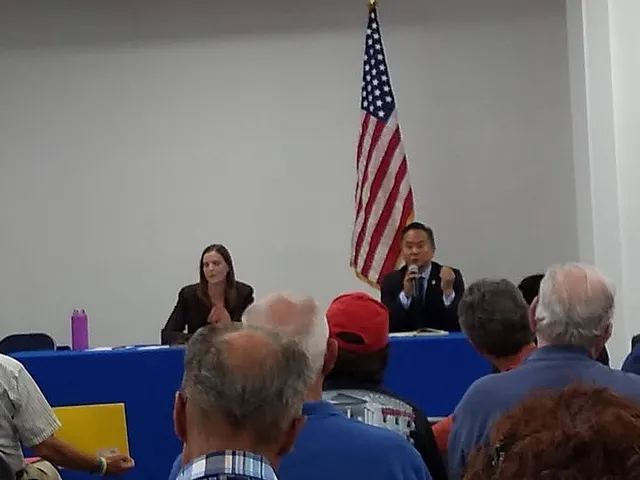
Commissioner president Manjusha Kulkarni said that his concealment of the investigation could have disadvantaged other candidates. “If voters were aware of the fact that he had gone to Hakkasan, which had a $30,000 tab, there would be some questions raised.” The backdating a check is a very serious act, a consciousness of guilt, she said. She added, “There were numerous opportunities for Lee to refuse the gifts, and not to engage in the activities in Las Vegas,” including the poker night and restaurants in 2016, and the nightclub in 2017.
After the second vote, the Commission moved on to decide the amount of the penalties. It was decided to accept the recommendation of the director of enforcement: $138,124.32, the maximum penalty.
Lee could appeal this decision in L.A. County Superior Court.
As for the other players in this pay for play scenario, José Huizar was sentenced to 13 years in federal prison on January 26, 2024. On October 4, 2024, Raymond Chan was sentenced to 12 years for racketing. George Chiang was sentenced to 12 months of home detention and community service on November 5, 2024. George Esparza was given three years of probation as a result of helping FBI obtain the other convictions on November 8, 2024. Another lobbyist associated with Huizar, Morrie Goldman was sentenced to 6 months of home detention on November 4, 2024.
According to the Los Angeles Time, Andrew Wang has never been arrested or charged.
In past years, there’s been plenty of City Hall scandals, including one involving Antonio Villaraigosa. While mayor of Los Angeles, he was fined almost $42,000 in April 2011 for failing to report tickets for 34 events. This was less than the $167,000 that the State Fair Political Practices Commission and the L.A. City Ethics Commission was considering, but was reduced as investigators felt his actions were unintentional.
One scandal ensnared the city council president and two other council members in October 2022 when an audiotape was leaked that contained racist comments.
A TIMELINE OF EVENTS CONCERNING THE ETHICS INVESTIGATION OF JOHN LEE
(Compiled from the documents presented to the Ethics Commission at its December 2025 meeting, the 2017 indictment against Englander, a Laist 2020 article, and from my book):
Names mentioned in the timeline:
Michael Bai, designated by the FBI as “Lobbyist A”
Raymond Chan, former head of the LA Dept. of Building and Safety until 2016; served for a year as LA deputy mayor for economic development until June 2017
George Chiang, Granada Hills real estate developer
Stephen Colon, chief investigator, Ethics Commission
Mitchell Englander, former council member of LA city CD-12
George Esparza, a council aide for then councilmember José Huizar
José Huizar, council member from 2005 to 2020
John Lee, current council member for LA city CD-12
Christopher Pak, developer who is also an architect and the owner of Archeon Group.
Andrew Wang, designated by the FBI as “Businessman A”
Ji-Lan Zang, ALJ from the Office of Administrative Hearings for the State of California
2016: Lee officially met Wang at a lunch meeting arranged by Bai (Englander also present). Wang paid for the lunch.
December 2, 2016: Lee, Wang, Bai and another had a dinner that was paid for by Wang.
February 15, 2016: The FBI serves a search warrant against Yahoo asking for access to Huizar’s personal email account.
March 31, 2017: Lee filed his annual Form 700, but did not report any gifts between January 1 through December 31, 2016.
April or May 2017: Lee and Englander attended a poker night with Wang, Pak. Wang paid for the night, which included alcohol and hostess service.
May 2017: Lee announced he would be leaving his position. Bai suggested a group trip to Las Vegas to celebrate. Wang and Bai arranged the trip after receiving a text from Englander,
June 1, 2017: Lee, Englander, Wang, Bai, Pak, Esparza, flew to LV (Lee paid for his flights). Wang used his VIP status with the Aria Hotel to get comped for hotel rooms, room amenities limo service dinner at a high end restaurant. He also gave gambling chips to everyone (Englander returned them). Then they went to a nightclub where Wang and Pak paid for bottle service. Wang said Lee and Englander gave him $100 each in cash but Englander said they both gave him $200 each. Lee said he arrived later after everyone else ate and only tasted the dessert, which he didn’t like, but did have some drinks. According to the FBI indictment, Englander received an envelope containing $10,000 from Wang.
June 2, 2017: Englander and Lee stayed a second night, which was comped by the hotel.
June 3, 2017: Lee sent Wang a text message thanking him for the trip.
June 5, 2017: The FBI and US Attorney’s Office (USAO) start investigation about Englander, based on “a judicially authorized intercepted phone call referencing benefits received by public officials from Businessperson A,” as part of an ongoing corruption investigation against City officials, including then council member Huizar.
June 12, 2017: John Lee officially left City service. In Palm Springs, Englander received an envelope containing $5,000 from Wang.
June 19, 2017: Englander introduces Wang to another developer at a lunch meeting.
June 23, 2017: Lee filed his “leaving office” form 700, which covered January 1 through June 12, 2017. He did not report receiving any gifts. (This form wasn’t found on the Ethics Commission data portal.)
July 11, 2017: The FBI contacts Lee, asking for an interview.
July 13, 2017: The FBI asks Lee again for an interview.
July 19, 2017: The FBI interviews Wang.
August 10, 2017: Wang begins cooperating with the FBI and USAO.
August 16, 2017: The FBI interviewed Lee as part of a federal investigation into corruption charges against City officials. Lee mentioned the lunch in 2016 with Wang and the subsequent dinner later that year. He said he didn’t pay for the meals. (In Englander’s 2025 declaration, Lee and Englander then discussed his questioning by the FBI about the Las Vegas trip. Then he message Wang via the encrypted messaging system Confide, that he and Lee decided to reimburse Wang for part of the trip.)
September 1, 2017: The FBI contacted Englander about a voluntary interview. Around then, Englander and Lee had another discussion about reimbursing Wang for some costs from the trip, but Lee suggested they backdate the checks to August 4, 2017, according the FBI indictment. He gave Englander a back dated check payable to Wang for $442. Englander added a check for the same amount which he dated August 4, 2017 (which was a date before any interviews by Lee and Englander with the FBI), and mailed them to Wang.
September 14, 2017: Wang received Fed Ex package that contains two checks for $442 each from Englander and Lee. Checks are labeled “Vegas expenses” and dated Aug. 4, 2017.
October 4, 2017: Englander allegedly meets Want for lunch and discusses FBI investigation.
October 19, 2017: Englander interviews with the FBI with his attorney present and allegedly lies, saying he hasn’t told anyone about this interview.
November 3, 2017: Lee was interviewed a second time by the FBI. (At both the August and November interviews, he didn’t mention arriving late at the dinner in Las Vegas and not consuming food).
January 31, 2018: Wang sends Englander a Confide message mentioning the FBI had asked to “follow up about the check.” Englander allegedly responded, “…I got a call too. Very stupid. They are waiting [sic] their time with this.”
Jan. 31-Feb 5, 2018: Englander and Wang continue to talk on Confide about the FBI investigation. Wang says they should talk in person. Englander suggests using a different phone number.
February 6, 2018: At an Englander fundraising event, Wang and Englander talk about the investigation, but Englander warns Wang, “you and I have never had a conversation… they are going to ask,” and “you should just say ‘I don’t know.’” Englander also allegedly tells Wang to lie and say Englander had tried multiple times to reimburse them for Vegas expenses. The indictment also alleges Englander told Wang not to say anything about escorts, referring to a “massage lady.” Englander said, “Don’t say it…don’t mention… No, no, don’t mention it.”
February 7, 2018: Englander interviewed by FBI a second time. He allegedly lies about whether he knew Wang would be at his fundraiser, if he knew how much the Vegas bottle service cost, and if he received any other gifts.
February 12, 2018: Englander and Wang meet in Englander’s car. According to the indictment, Englander turns the stereo up very loud in case of listening devices and drives in circles. Englander tells the individual to lie to investigators and says “we never had a conversation.” Englander also tells Wang how to lie about calling the escort service in Las Vegas, ultimately deciding, “No, just say, ‘I don’t remember’” and “No, I didn’t hire anybody.” Englander finally agrees to introduce the Businessperson to his builder “friend.”
April 12, 2018: Englander files his Form 700, but doesn’t list the $15,000 cash and other gifts from Wang.
July 20, 2018 FBI serves a search warrant against Google under money laundering and bribery statutes. The warrant asks for information contained in Chan’s Gmail. Also named: Huizar, family members and other city hall aides; Councilman Curren Price; Deron Williams, chief of staff to Herb Wesson; and Joel Jacinto, a member of the city’s board of public works.
The warrant mentions seeking records for information on “development projects in and around Los Angeles that relate to foreign investors.”
Oceanwide Holdings and other Chinese development companies are also found in the pages of the search warrant.
October 11, 2018: Englander announced he was resigning from the City Council.
November 7, 2018: The FBI raids the office and home of Huizar using a hard drive-sniffing dog. Agents leaving one office have a filing box labeled “Fundraising.” The article in the L.A. Times about this raid doesn’t mention Englander and Lee.
November 20, 2018: Englander meets with Wang, according to the indictment, and discusses the FBI investigation into his Vegas and Palm Springs trips.
December 31, 2018: FBI interviews Englander a 3rd time. He allegedly lies about cash and gifts from Businessperson A, and says he can’t remember ever using the Confide app.
Englander officially resigns from the city council.
January 1, 2019: An L.A. Times article said the federal investigation had expanded to include Chan and other City officials. Englander and Lee weren’t not mentioned.
January 11, 2019: Seamus Hughes with George Washington University tweets the warrant on Chan’s Gmail account. This is the first chance journalists and the public have for a better understanding of how wide and deep the FBI probe into L.A. City Hall may go.
Early 2019: The Ethics Commission’s Audit Division investigated Wang for suspected money laundering through political contributions.
June 4, 2019: A special primary election was held to fill Englander’s seat for the remainder of his term, with 15 candidates on the ballot. Voters were unaware of any federal investigation about a trip Lee took.
August 13, 2019: Runoff election to fill Englander’s seat was held. Voters were still unaware about the FBI investigation. Even after being elected, Lee did not amend his previous Form 700s for the gifts he received in 2016 and 2017.
March 3, 2020: Election for the full term CD-12 seat was held. Voters had not been informed about the FBI’s investigation. Lee did not amend his previous Form 700s for the gifts he received in 2016 and 2017.
March 9, 2020: The DOJ issued a press release announcing that Englander was named in a now unsealed indictment that had been returned by a federal grand jury on January 16, 2020. Englander surrendered to the FBI, facing seven counts for obstructing a federal investigation. He plead “not guilty” and is released on $50,000 bail. His trial date is later set for May 5. (The indictment refer to “two city staffers” but didn’t list their names).
March 13, 2020: A Times article identified Wang as Businessman A who gave Englander gifts on June 1, 2017.
March 24, 2020: The Ethics Commission received an anonymous whistleblower complaint against Lee.
March 27, 2020: Englander agrees to plead guilty to one count of “scheming to falsify material facts.” As part of the agreement, Englander admitted that he made false statements to the FBI and federal prosecutors on three separate occasions in 2017 and 2018.
May 13, 2020: Chiang agrees to plead guilty in connection with a scheme to bribe public officials — including an unnamed member of the Los Angeles City Council — to smooth the passage of real estate projects.
May 14, 2020: The Commission assigned Colon to investigate a possible ethics complaint against Lee.
The City Council President asks Huizar not to attend any more council meetings until there’s “legal clarity” regarding his involvement in the city’s “pay-to-play” bribery scheme. Following that request, several city leaders call on Huizar to resign. The councilmember says he will “limit” his participation at City Hall, but does not announce his resignation.
May 27, 2020: Esparza agrees to plead guilty to one count of conspiring to violate the Racketeer Influenced and Corrupt Organization (RICO) statute.
June 4, 2020: The Granada Hills South Neighborhood Council passes a resolution asking the LA City Ethics Commission to start an investigation into Lee’s participation in the Las Vegas trip..
June 23, 2020: Huizar is arrested on a federal racketeering charge, allegedly accepting at least $1.5 million in bribes, using his position to conduct and cover up illicit activities, such as accepting bribes from developers.
June 24, 2020: The Porter Ranch Neighborhood Council cancels a special meeting that was scheduled to consider a resolution about John Lee after a city attorney advised the council to drop the subject.
July 6, 2020: Northridge East Neighborhood Council’s executive committee recommended the board send a letter of inquiry into whether Lee was “City Staffer B” after a request by several stakeholders.
July 7, 2020: Englander pled guilty to count one of the indictment, which charged Englander with a scheme to falsify material facts.
July 15, 2020: A resolution regarding “City Staffer B” was on the agenda for the Northridge East Neighborhood Council general meeting. But in the morning, the president emailed the council that city attorney Elise Ruden advised him to not hear the item. A revised resolution was sent to the city attorney, who said it wasn’t acceptable to ask Lee if he was the person referred to in the indictment. A document entitled “Personal Liability for Neighborhood Council Board Members” was attached to the attorney’s response.
At the meeting, public comments in favor of a resolution convinced the board to place the item back on the agenda. The resolution that was passed, called not just for clarification from Lee if he is “Staffer B,” but to also request the Ethics Commission to look into Lee’s involvement in the Planning and Land Use Management committee considering his involvement in the investigation.
July 30, 2020: A federal grand jury returns a 34-count indictment against Huizar, including that he illegally took more than $800,000 in benefits from a “Chinese billionaire who runs a multinational development firm and who owns a hotel in Huizar’s district.” It also alleged that he used “ family members to launder hundreds of thousands of dollars in bribes, making false statements on a bank loan application and failing to report his illicit benefits on tax returns and ethics disclosure forms.
January 25, 2021: Englander was ordered to pay a fine of $15,000 and sentenced to a term of 14 months in federal prison.
January 26, 2021: Colon held a Zoom meeting with the FBI and the USAO to discuss the Commission’s intent to investigate both Englander and Lee. The FBI requested that the Commission delay any interviews of Wang due to other pending federal investigations.
January 11, 2021: FBI’s transcription of a conversation between “confidential human source (CHS), which is Andrew Wang, and Englander is released.
June 2021: Englander starts his prison sentence.
January 10, 2022: The Ethics Commission files an Accusation against Englander relating to his receipt of gifts from Wang and Pak.
February 24, 2022: Colon contacted Lee by telephone and informed him that the Commission was investigating gifts he’d received during the June 2017 Las Vegas trip.
February 25, 2022: Colon followed up his phone call from the day before with a letter requested that Lee provide certain information about that trip.
March 16, 2022: Lee’s counsel replied in writing that Lee refused to provide the requested information because the allegations against him allegedly occurred “well outside of the four-year statute of limitations.”
April 7, 2022: Lee responded to the request by Colon and also asked the FBI to release the reports of the two interviews with that agency to the Commission.
May 27, 2022: Colon received the FBI files on Lee’s interviews.
July 21, 2022: Englander entered into a stipulation with the Ethics Commission and paid a penalty of $79,830.50 to resolve the violation. It included an admission that he misused his position as a member of the City Council to create a private advantage for himself, specifically, by using his position as a vehicle to obtain gifts from Wang and Pak that exceeded the gift limits and by keeping the gifts secret,” which violated the LAMC.
October 25, 2022: Colon sent a proposed settlement agreement to Lee’s counsel.
April 2, 2023: Lee’s counsel informed the Commission that he was refusing the proposed settlement agreement.
June 6, 2023: the Commission investigator issued a probable cause report to Lee.
June 21, 2023: Lee was interviewed by the Ethics Commission.
August 18, 2023: Nomination for a position on the Ethics Commission was pulled at the last minute during a city council meeting under suspicious circumstances. Some members of the public suspected it was done to protect Lee.
August 31, 2023: Probable cause conference in Lee’s case was held.
September 22, 2023: A written determination was issued that there was probable cause that Lee committed ten violations.
September 26, 2023: The Commission filed the Accusation against Lee.
October 27, 2023: Lee filed a lawsuit against the Commission, on the basis that the enforcement of the alleged violations came too late, and calling the accusation “misguided and false.”
November 8, 2023: Ethics Commission passed motion to set an administrative hearing.
March 5, 2024: Lee ran for reelection, but had not amend previous Form 700s to reflect gifts received in 2016 and 2017.
February 2, 2025: Englander completed his supervised release for his conviction.
April 25, 2025: Englander gave a declaration for Lee’s hearing.
June 2–6. 2025: Administrative hearing held concerning the accusations against Lee.
December 12, 2025: ALJ released her recommendations in Lee’s case.
December 17, 2025: Special Ethics Commission meeting discussed the charges against Lee and penalties.
DID THE CITY CENSOR DISCUSSION BY NEIGHBORHOOD COUNCILS?
After Mitchell Englander’s arrest in March 2020, many residents wanted to know if John Lee would be investigated for his part in the Las Vegas trip. But when stakeholders were bringing the topic to their neighborhood councils, requesting a resolution calling for an ethics investigation, a strange pattern started to appear. Some NCs that placed the topic on their agendas received an email from the lawyer overseeing legal matters for the councils, instructing them not to discuss the topic.
As other NCs have encountered similar orders when planning to discuss other issues, I will look into these cases for a separate article.
END OF THE YEAR GAS BLAST
Those who have the PRCAMP app for the Argos monitoring system (Page 170) received a notification on December 27th at 5:21 pm regarding elevated levels of methane. But as it turned out, the methane may have been coming from sources other than the Aliso Canyon facility.

An hour before, a gas line rupture in Castaic caused the air for miles to be filled with the smell of mercaptans. The smell of those odorants spread south to the San Fernando Valley, and were reported as far south as Sherman Oaks and Studio City, more than 26 miles from the site of the rupture. Many residents called SoCalGas while others called the AQMD hotline (1–800-cut-smog) to report the strong odor.

A nearby resident told KTLA that they heard a loud noise and their house shook. Some felt it sounded like the roar of a jet engine. Many news crews captured overhead footage showed giant plumes of dust rising from the broken pipeline, as well as a collapsed hillside nearby.
The California Highway Patrol shut down both sides of Interstate 5 in Castaic, causing major backups. The shelter-in-place order was lifted four hours after the incident began.
Experts said the heavy rains, that hit Southern California for several days before, likely caused a landslide that caused the problem. According to ABC7, “Fire officials confirmed the leak came from a 34-inch transmission line ‒ a major natural gas pipe that runs near the freeway. Officials explained that the pipe was under extreme pressure, and when it failed, the gas was released forcefully, kicking up dirt and debris, which was visible to drivers in the area.”
On the same day, the LAFD tweeted about a leak in northern Granada Hills.
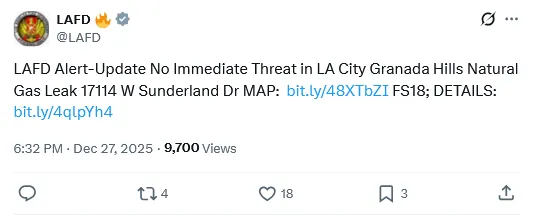
Inexplicably, SoCalGas didn’t post any tweets that day about what happened in Castaic, even though some elected officers did. The utility did give an update on its website about the Castaic problem on December 31st, but never mentioned any other leaks.
The California Council on Science and Technology’s Long-Term Viability of Underground Natural Gas Storage in California report discussed the risk of landslides at some of the underground storage facilities, including Aliso Canyon and the Honor Rancho site, which is about four miles to the southeast of where the pipeline ruptured.
OTHER UPDATES:
TITLE V PERMIT FOR THE ALISO FACILITY
As I noted on page 340 of the book, the AQMD issues Title V permits for facilities such as the Aliso Canyon gas storage facility. The last permit for Aliso expired in January 16, 2025, but the agency has spent several months reviewing the newest edition.
An air quality engineer involved in the process told this writer that a 30-day period for public comment will be starting now (mid-January 2026). So far, there is no information about this step on the AQMD website.
THE 2025 HAZARDOUS WASTE MANAGEMENT PLAN
SB-158 created the Board of Environmental Safety (BES) to provide oversight over the Department of Toxic Substances Control (DTSC). One provision of this bill was requiring the DTSC in devising a Hazardous Waste Management Plan (Page 333).
VENTURA COMPRESSOR MODERNIZATION PROJECT
Regarding the Ventura compressor Station Modernization Project (pages 203–205), the CPUC is still working on the CEQA document. Per the CPUC website, “The CPUC plans to publish the CEQA environmental document in the first half of 2026.”
Proceeding A23–08–019 is still active.
SUNSHINE CANYON LANDFILL
During 2025, AQMD has received 2,930 odor complaints concerning the Sunshine Canyon landfill and has issued 89 NOVs.
The Board of Supervisors haven’t passed any new waivers to allow Sunshine to accept fire debris. According to the monthly tonnage reports, the last day the landfill received any “disaster debris” was on August 21, 2025.
THE LOS ANGELES URBAN FIRES
With the anniversary of the onset of the worst fires in Los Angeles history (pages 323–339), there’s a spotlight on the many studies being conducted including on health risks , as well as how to cut down on the possibility of similar disasters happening in the future.
The Los Angeles Fire Human Exposure and Long-Term Health Study (LA Fire HEALTH) has been releasing findings all along.
The California state website has been tracking the recovery. Among one of the findings concerns the chance of developing a heart attack, lung complications, or general illness within ten days after the start of the fire siege.
CEC BUILDING CODES
New building codes went into effect in 2026 (page 198). The California Energy Commission has started work on the 2028 Building Energy Efficiency Standards, currently in the Pre-Rulemaking stage.
COURT CASES RE SB-1137
In 2025, two lawsuits were filed against SB-1137, the setback bill that was passed in 2022 (page 301). One was filed by the “Native Oil Producers and Employees of California” against the state and the Department of Conservation Geologic Energy Management Division (Cal-GEM). Included in the plaintiffs are oil companies, including Termo Oil, which operates several wells above Porter Ranch. The other lawsuit was filed by “Monte Beard, Sr. and Merry Vanderwaal” is also against the state and Cal-GEM. The next scheduled hearings for both in LA Superior Court will be on January 23, 2026, in the same courtroom. Beard and Vanderwaal are owners of subsurface oil and gas hydrocarbon reserves in Long Beach.
THE EPA
In January 2026, the EPA will change how air-pollution rules will be determine. Even of considering the human toll from deadly pollutants, decisions will be made based on business costs. (Page 213–214.)
CLIMATE CHANGE
Typhoon Halong hit Alaska causing flooding between October 8 and October 13, 2025. One person in Japan and one in Kwigillingok in western Alaska lost their lives. Much of the coast of Alaska became flooded, causing extensive damage. One retire professor of environmental health who resides in Alaska said the storm was caused by climate change. A Grist article pinpointed the ways that this typhoon is just one way climate change is affecting the state. Public Employees for Environmental Responsibility and the Sierra Club are among the organizations discussing this example of how storms are intensified by climate change.
Tempe, Arizona was hit by a supercell thunderstorm on October 14, which caused widespread flooding and damage from the hurricane force winds.
But sadly, the Trump administration, which has been following Project 2025, still refuses to consider how increasing the use of fossil fuels will adversely impact our weather and eliminated several National Weather Service positions. (Page 215 in the book.)
WE GOT PRESS
Between October and December 2025, several articles and stories were published about Aliso Canyon and the 10th anniversary of what is still the biggest release of toxic gas in US history. In the case of a paywall, an alternative link is also provided.
This article discusses various new technologies, including emissions detection. It also does bring up the fire and seismic risks that won’t go away. It also has a photo of a sit in that happened in May 2016, but that was mostly environmental groups (which held a march the day before in downtown LA) and not residents.
2. https://laist.com/news/climate-environment/aliso-canyon-natural-gas-blowout-ten-years-whats-changed
This article includes interviews with Kyoko Hibino, Jamie DeRosa, and Dr. Nordella talking about the health effects from Aliso, that SoCalGas continues to deny; Dr. Michael Jerrett discussing contaminants found from Aliso; Issam Najm discussing the chemical emissions detected by air monitoring and the work toward decarbonization; the sustainability projects being funded by penalties assessed against SoCalGas
(Newsbreak reprinted with a link to the interview: https://www.newsbreak.com/knx-1070-news-radio-560915/4309658397856-a-decade-later-porter-ranch-residents-still-haunted-by-aliso-canyon-explosion)
Interview with Matt Pakucko on how Aliso is still causing health problems and his prediction that there will be another disaster because of SoCalGas’s negligence before the facility ever gets shut down permanently. It also mentions Kyoko Hibino’s health crisis due to Aliso.
(original link: https://www.dailynews.com/2025/10/16/residents-still-waiting-for-full-results-of-aliso-canyon-disaster-health-study-a-decade-later/)
About the health study that’s ongoing.
SoCalGas is leaning into the bullshit that many public agencies gave right off the bat: that any symptoms were from the odorants added to the methane gas. Even after the DPH had to admit they were wrong after testing found there were heavy metals found in homes, the gas company continued to claim there weren’t any health effects.
The Community Advisory Group mentioned in the article pushed hard for the clinical study and for independent researchers for the Scientific Oversight Committee (especially to get Dr. Nordella on it as DPH was resisting putting on a medical doctor who was a clinician on the SOC). We spent a lot of hours during our existence with many discussions and meetings outside those held with DPH.
(original link: https://www.dailynews.com/2025/10/16/10-years-after-aliso-canyon-gas-blowout-disaster-families-still-live-with-uncertainty/)
This one is about what many went through ten years ago. SCG brought up its own advisory council (which I dubbed the Shadow Council in my book on page 177–178) because it was operated in secret: no public meetings nor any public minutes). In addition, the gas company is ignoring the findings coming out from the health study.
(original link: https://www.dailynews.com/2025/10/16/porter-ranch-resident-hopes-crowd-sourcing-of-gas-to-all-electric-homes-will-help-close-aliso-canyon/)
At the bottom of page 4 of the PDF there’s a major mistake by either the reporter or the Sierra Club. It seems to mix up the penalties assessed against SCG for negligently causing the blowout (some $610.1 million for the violation of Public Utilities Code section 451; of which $71 million went into an Aliso Recovery Fund…and that money went into the 2024 state budget bill AB-157 to be used for the sustainability project that the Sierra Club was referencing, $40 million of which would be used to install heat pumps and electric water heaters) and the 2018 Consent Decree (which was almost $120 million, which included allotments for the health study and the air monitoring system that Argos Scientific installed).
The Sierra Club was just one of the many organizations that helped advised the state senate’s energy consultant who was putting together the plan to use the $71 million. The Aliso Moms Alliance, Save Porter Ranch, and Food & Water Watch had at least a few meetings with this consultant and State Senator Henry Stern during the summer of 2024 about what to do with this money, and we insisted that the Aliso-affected area be prioritized. I’m guessing that the Sierra Club was requesting all of LA county be able to apply for the funds, instead of the area most directly affected by the disaster.
Marc Jacobson’s letter that was signed off on by many scientists and requested that Aliso be closed, was also mentioned.
(original link: https://www.dailynews.com/2025/10/16/after-the-aliso-canyon-blowout-volunteers-organized-spoke-out-got-governors-ear/
This article was problematic, as it gives hero status to some who were only involved in the early days of the disaster.
Additionally, the president of the PRNC at the time of the onset of the blowout, Paula Cracium, claimed that she got Erin Brockovich to come to Porter Ranch to speak. But the famous activist came to help get residents to sign up as plaintiffs for the law firm she consults for. I looked for Aliso posts on Erin’s Facebook page and she discusses the law firm, but I don’t see anything about from her saying she was asked by the PRNC to come to our community.
One article she linked to says this: “Brockovich said she received requests for assistance from hundreds of Porter Ranch residents.”
Erin mentioned that she was feeling the effects after being up here for about a week (I think she lives in the south west part of Los Angeles County).
(original link: https://www.dailynews.com/2025/10/16/socalgas-paid-out-more-than-2-billion-in-settlements-from-aliso-canyon-gas-leak/)
This article talks about many of the settlements against SCG for the blowout. It mentions the $4.3 one to settle a criminal case brought by the county in 2016 (all but one of the criminal charges got dropped). SCG was required to install methane monitors but its press release made it seem like they were installing these out of the goodness of their heart.
The $119.5M was for the consent decree between state, county, and city attorneys and SCG. $3 million to two methane/BTEX monitoring systems — one for Porter Ranch and one for an EJ community. $25 m for the long desired health study. And $26.5 M for a dairy digesters project to produce biomethane from cow poop that SCG can then store at Aliso to sell (so you can see why residents were pissed at CARB for approving this).
$1.8 billion was paid out by SoCalGas to keep the trial for the mass tort from happening (and SCG executives would have to testify and the chemical list would undoubtedly be made public). The major law firms (out of the zillion firms with clients) got a big slice of the money in common benefit fees. This settlement was announced in September 2021 without any consultation or advance notice to the plaintiffs. $610.1 million was assessed by the CPUC for the gas company’s negligence that caused the blowout (the article makes it seem it was just $105.1m but it’s more complicated than that). The $71 million was transferred to the Aliso Canyon Recovery Account (the money to cover the investigation and the ratepayer refund did NOT come from this amount but out of the $61.0.1 million total). The money in the ACRA was transferred to the TECH account that was created to help decarbonize homes, thanks to our state senator who authored SB-1477 in 2018. $40 million will go to the Healthy Homes sustainability project to be prioritized for the Aliso-affected area (communities within ten miles of the blown out well) to install heat pumps and other appliances. $15 million for school yard greening in our area. $14 million for efficient air condition upgrades for senior centers in our area. $2 million for an outreach and education program, which will be discussed later in this article A resident started a lawsuit in late 2015 against SCG and then joined by the Center for Environmental Health, which based their complaint on violations of Prop 65. In 2022, they got a judgement, which resulted in BTEX monitors (installed by Sonoma).
The article left out other settlements and fines. There was the February 2017 smoke-filled courtroom deal between SCG lawyers and South Coast AQMD lawyers for $8.5 million to resolve the AQMD lawsuit brought when they realized that SCG was reneging on the health study required by the abatement order. I called the chapter describing this one “Betrayal” as only one million dollars was allocated to a “health study.” (Also, one million went to a pet project of SCG, involving waste products.) Residents basically told off the AQMD health team when they gave a presentation for a study that we knew would just be a risk assessment. In 2022, the AQMD governing board decided to transfer the million to add to the consent decree money for the air monitoring system (that would be soon assigned to Argos).
Also left out was the class action lawsuit settlement for approximately $40 million and separate from the mass tort. Seven residents had filed this suit and was not folded into the mass tort. Checks were sent to anyone (supposedly) who wasn’t a plaintiff in the mass tort and who lived within 5 miles of the damaged well, to take care of the loss of property values. I say supposedly because somehow some of the plaintiffs got sent checks too (checks for non-plaintiffs amounted to almost $400 in June 2022 and then another smaller check got sent a half a year later). If mass tort plaintiffs cashed the class action check, they got screwed as they would be eliminated from the tort settlement…which lead to some irate posts on NextDoor and on Facebook about this.
The same week as the CEH settlement, SCG got hit by a $10 million fine as a result of a Public Advocates suit for improper use of ratepayer money for advocating for itself.
Attorney General Rob Bonta hit SCG with a $175k fine in 2023 for its false messaging that their gas is “renewable.”
This article mentions the misinformation and lack of transparency given to residents during the blowout about health risks. Another mention of SoCalGas’s fake advisory council and its continued claims that there are no health problems caused by the disaster, despite the findings being published by UCLA. Mention of the biennial assessment that came out on October 1st. The article states that the PRCAMP air monitoring project was launched in 2017. In reality, the funding came from the 2018 consent decree and the monitors for both methane and BTEX chemicals were installed in 2022.
Timeline of events concerning Aliso through February 20, 2020
Various graphs and data regarding the blowout, the use of methane in the US, pipelines in the western US. NOTE: some of the dates listed under “notable events following the leak” are missing the year.
Article discusses the biennial assessment and how capacity at Aliso has changed over the years; the heath study findings, but also how SoCalGas continues to stick to its “no health risks’ mantra; transitioning to clean energy; whether Governor Newsom is sticking with his promise to shut Aliso down.
A preview of the town hall
The Daily News article discussed the town hall, including the updates on the health study. Brad Sherman was interviewed and criticized SCG for not looking for alternatives to using AC.
15. Environmental Defense Fund article:
Discussions how the blowout has impacted the climate and has triggered federal regulations and “practices” regarding methane storage facilities.
16. SCV News:
https://scvnews.com/oct-26-aliso-canyon-survivors-to-mark-10-years-since-gas-blowout/ Mentions the upcoming town hall as listed in the Food & Water Watch press release.
17. Daily Kos:
Quotes from the Food & Water Watch press release Kyoko Hibino, Helen Attai, and this writer about the health and safety risks from the Aliso Canyon storage facility and the lack of action by elected officers and public agencies.
The article discusses the low birth weight finding from the health study. SoCalGas also gives its claims that “safety” changes it has enacted make the facility safe.
19. The Granada Hills North Neighborhood Council posted this to their website: https://ghnnc.org/2025/10/10-years-after-aliso-canyon-blowout-closure-demanded-by-granada-hills-northridge-and-porter-ranch-residents/ https://ghnnc.org/2025/10/10-years-after-aliso-canyon-blowout-closure-demanded-by-granada-hills-northridge-and-porter-ranch-residents/
20. The Food & Water Watch press release:
21. This writer’s article about the town hall: https://pattyglueck.medium.com/sfv-residents-will-mark-10th-anniversary-of-the-aliso-canyon-gas-blowout-with-town-hall-12ced548473c
Disclaimer: I was a volunteer canvasser/phone banker for the Lundquist and Oberstein campaigns in 2019, 2020, and 2024
Comments